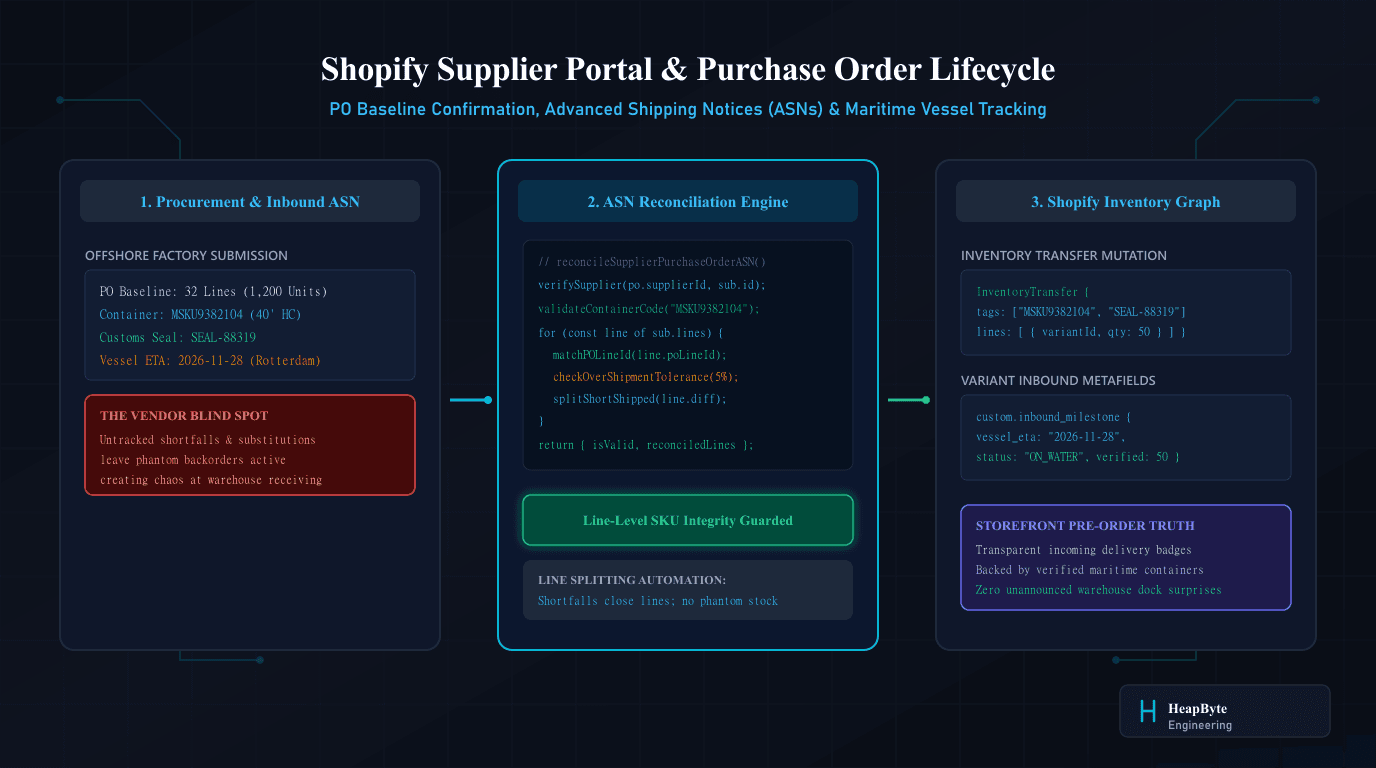
The vendor blind spot in Shopify B2B architecture
When merchants scale procurement on Shopify, they often assume Shopify's B2B suite includes vendor management, mistaking the 'PO Number' field on checkout screens for procurement tracking.
In reality, Shopify's PO number is an untrusted string supplied by a customer to reference their accounting voucher when purchasing from you. Shopify has no native model for external vendors as collaborative counterparties.
Merchants attempting to manage procurement inside Shopify hit three immediate bottlenecks: staff account sprawl (where granting factory access exposes storewide metrics and margins), email and spreadsheet drift (where factory revisions detach from original orders), and the maritime black hole (where transfers track origin and destination but cannot represent maritime containers, bill of lading codes, or customs holds).
As outlined in our foundational work on Shopify supplier portal architecture, solving this requires treating the supplier portal as an autonomous application that mediates between your procurement baseline and your storefront.
The three operational milestones: Confirmation, ASN, and Landing
A resilient supplier operations engine models the purchase order lifecycle through three distinct operational gates:
1. Supplier Confirmation: Within forty-eight hours of receiving a purchase order, the supplier authenticates into the portal and reviews each requested line item. The supplier commits to the quantity, confirms the target ex-factory dispatch date, or flags yield shortages (for example, committing to 450 units instead of 500). Once submitted, the confirmation locks the production baseline.
2. Advanced Shipping Notice (ASN): Weeks later, when goods are packed into shipping containers or handed to a freight forwarder, the vendor submits an ASN. The ASN is the legal declaration of what has physically departed. The vendor inputs the carrier, vessel identifier, container number, customs seal code, and an itemised carton breakdown recording how many units of each line item were sealed into the container.
3. Port Landing and Customs Clearance: When the vessel berths and the container clears customs, the milestone tracker updates the shipment status to landed. Only at this junction does the warehouse receiving team receive a verified dock appointment schedule, equipped with an exact manifest matching the physical container seal.
Tolerances and discrepancies: handling partials and substitutions
The most dangerous assumption in supply chain software is that suppliers ship what you ordered. In bespoke furniture, apparel confection, and industrial hardware, production yields vary.
A production batch of hand-glazed ceramic lamp bases may suffer an 8% kiln defect rate. An offshore supplier cannot easily re-run eight defective units to satisfy an exact order of one hundred; they pack the ninety-two surviving units and seal the crate.
If your integration engine naively expects an all-or-nothing delivery, two failure modes occur: orphaned backorders (where missing units linger permanently as incoming stock and trigger unfulfillable customer backorders) and unannounced substitutions (where factories replace missing items with alternative finishes or models).
A production-grade supplier portal enforces mathematical tolerance boundaries. When an ASN is submitted, the reconciliation engine calculates the variance per line. If a line shortfall is marked as final, the portal automatically splits the purchase order line: marking the shipped quantity as in-transit, and cancelling or backordering the remainder so financial accounts and storefront pre-order allocations remain truthful.
Pure reconciliation: validating ASNs against purchase orders
The reconciliation engine must be pure and deterministic. It verifies that every line item in the supplier's ASN corresponds to an active purchase order line, flags quantity discrepancies against commercial agreements, and validates container shipping metadata before updating Shopify or ERP records:
export interface PurchaseOrderLine {
  poLineId: string;
  variantId: string;
  sku: string;
  quantityOrdered: number;
  unitCost: number;
}

export interface AsnLineItemInput {
  poLineId: string;
  sku: string;
  quantityShipped: number;
  cartonCount: number;
}

export interface AsnSubmissionPayload {
  purchaseOrderId: string;
  supplierId: string;
  containerNumber: string;
  sealNumber: string;
  billOfLading: string;
  vesselEta: string; // ISO 8601
  lines: AsnLineItemInput[];
}

export interface ReconciledLineResult {
  poLineId: string;
  sku: string;
  variantId: string;
  quantityOrdered: number;
  quantityShipped: number;
  quantityDiscrepancy: number; // shipped - ordered
  status: "MATCHED" | "SHORT_SHIPPED" | "OVER_SHIPPED";
  cartonCount: number;
}

export interface AsnReconciliationResult {
  purchaseOrderId: string;
  isValid: boolean;
  containerReference: string;
  vesselEta: string;
  reconciledLines: ReconciledLineResult[];
  summary: {
    totalUnitsOrdered: number;
    totalUnitsShipped: number;
    totalCartons: number;
    hasDiscrepancies: boolean;
  };
  errors: string[];
  warnings: string[];
}

export function reconcileSupplierPurchaseOrderASN(params: {
  purchaseOrder: {
    id: string;
    supplierId: string;
    lines: PurchaseOrderLine[];
  };
  submission: AsnSubmissionPayload;
  allowOverShipmentThresholdPercent?: number; // e.g., 5%
}): AsnReconciliationResult {
  const { purchaseOrder, submission, allowOverShipmentThresholdPercent = 0 } = params;
  const errors: string[] = [];
  const warnings: string[] = [];

  // 1. Validate header counterparties and required container identifiers
  if (purchaseOrder.supplierId !== submission.supplierId) {
    errors.push(`Supplier mismatch: PO belongs to "${purchaseOrder.supplierId}", submission from "${submission.supplierId}".`);
  }

  const containerRegex = /^[A-Z]{4}\d{7}$/;
  const cleanContainer = submission.containerNumber.trim().toUpperCase();
  if (!containerRegex.test(cleanContainer)) {
    warnings.push(`Container identifier "${submission.containerNumber}" does not follow ISO 6346 formatting (e.g. MSKU1234567).`);
  }

  const etaTimestamp = Date.parse(submission.vesselEta);
  if (Number.isNaN(etaTimestamp) || etaTimestamp < Date.now() - 86400000) {
    errors.push(`Invalid or past vessel ETA provided: "${submission.vesselEta}".`);
  }

  // 2. Index baseline purchase order lines
  const poLineMap = new Map<string, PurchaseOrderLine>();
  let totalUnitsOrdered = 0;
  for (const line of purchaseOrder.lines) {
    poLineMap.set(line.poLineId, line);
    totalUnitsOrdered += line.quantityOrdered;
  }

  const reconciledLines: ReconciledLineResult[] = [];
  const processedPoLineIds = new Set<string>();
  let totalUnitsShipped = 0;
  let totalCartons = 0;

  // 3. Reconcile inbound ASN lines against baseline
  for (const submittedLine of submission.lines) {
    const baseline = poLineMap.get(submittedLine.poLineId);

    if (!baseline) {
      errors.push(`Unrecognised PO line ID "${submittedLine.poLineId}" (SKU "${submittedLine.sku}") not in purchase order.`);
      continue;
    }

    if (baseline.sku !== submittedLine.sku) {
      errors.push(`SKU mismatch on line ${submittedLine.poLineId}: expected "${baseline.sku}", got "${submittedLine.sku}".`);
      continue;
    }

    if (processedPoLineIds.has(submittedLine.poLineId)) {
      errors.push(`Duplicate ASN line entry for PO line "${submittedLine.poLineId}".`);
      continue;
    }
    processedPoLineIds.add(submittedLine.poLineId);

    if (submittedLine.quantityShipped <= 0 || !Number.isInteger(submittedLine.quantityShipped)) {
      errors.push(`Invalid shipped quantity (${submittedLine.quantityShipped}) for SKU "${submittedLine.sku}". Must be positive integer.`);
      continue;
    }

    const discrepancy = submittedLine.quantityShipped - baseline.quantityOrdered;
    let lineStatus: "MATCHED" | "SHORT_SHIPPED" | "OVER_SHIPPED" = "MATCHED";

    if (discrepancy < 0) {
      lineStatus = "SHORT_SHIPPED";
      warnings.push(`Line SKU "${baseline.sku}" short-shipped by ${Math.abs(discrepancy)} units.`);
    } else if (discrepancy > 0) {
      lineStatus = "OVER_SHIPPED";
      const allowedOverage = Math.ceil((baseline.quantityOrdered * allowOverShipmentThresholdPercent) / 100);
      if (discrepancy > allowedOverage) {
        errors.push(`Line SKU "${baseline.sku}" over-shipped by ${discrepancy} units (exceeds ${allowOverShipmentThresholdPercent}% allowance).`);
      } else {
        warnings.push(`Line SKU "${baseline.sku}" over-shipped within tolerance (+${discrepancy} units).`);
      }
    }

    totalUnitsShipped += submittedLine.quantityShipped;
    totalCartons += submittedLine.cartonCount;

    reconciledLines.push({
      poLineId: baseline.poLineId,
      sku: baseline.sku,
      variantId: baseline.variantId,
      quantityOrdered: baseline.quantityOrdered,
      quantityShipped: submittedLine.quantityShipped,
      quantityDiscrepancy: discrepancy,
      status: lineStatus,
      cartonCount: submittedLine.cartonCount,
    });
  }

  // 4. Check for completely missing PO lines
  for (const [poLineId, baseline] of poLineMap.entries()) {
    if (!processedPoLineIds.has(poLineId)) {
      warnings.push(`PO line "${poLineId}" (SKU "${baseline.sku}") completely omitted from ASN submission.`);
    }
  }

  return {
    purchaseOrderId: purchaseOrder.id,
    isValid: errors.length === 0,
    containerReference: cleanContainer,
    vesselEta: new Date(etaTimestamp).toISOString(),
    reconciledLines,
    summary: {
      totalUnitsOrdered,
      totalUnitsShipped,
      totalCartons,
      hasDiscrepancies: reconciledLines.some((l) => l.quantityDiscrepancy !== 0) || processedPoLineIds.size < poLineMap.size,
    },
    errors,
    warnings,
  };
}Connecting container milestones to Shopify inventory states
Once the reconciliation engine validates an ASN, the operational data bridges into Shopify's inventory graph:
1. Shopify Inventory Transfers: The engine creates or updates an InventoryTransfer pointing to the destination warehouse. It populates line quantities matching the reconciled ASN figures, tagging the transfer with container and bill of lading references.
2. Variant Inbound Metafields: For high-value or long-lead items, the engine writes structured JSON metafields on the ProductVariant entity (custom.inbound_milestone), storing container numbers, vessel ETAs, verified unit counts, and maritime status.
By exposing this metafield data, storefront themes render pre-order availability badges (such as '12 units arriving in late November; reserve yours now') backed by verified vessel tracking rather than merchant estimates.
Review our case studies in B2B operations and supplier workflows to see how brands connect multi-tier operational portals with central inventory engines.
What Shopify purchase order workflows cannot do
Understanding platform boundaries protects your procurement architecture from costly redesigns:
- Cannot grant partitioned vendor logins to Shopify Admin: Shopify staff accounts do not support vendor-level data tenancy. A supplier logged into Admin can see products, inventory, and orders belonging to other suppliers. Counterparty collaboration must live outside Admin.
- Cannot calculate landed cost valuations dynamically: While Shopify allows entering a static 'Cost per item', it cannot calculate landed costs (allocating ocean freight, port handling, customs tariffs, and maritime insurance proportionally across variant weights and cubic volumes). Landed cost accounting belongs in your ERP or accounting system.
- Cannot generate GS1-128 container distribution labels: Shopify's native label-printing tools generate basic product barcodes for retail shelves, not multi-level SSCC shipping container codes required for containerised freight.
- Cannot enforce multi-stage quality control sign-offs: Shopify transfers have no native gate for pre-shipment inspections, factory photo audits, or lab compliance certificates. Those checkpoints must be governed by an external workflow before triggering shipment authorizations.
When this needs an engineer
You do not need an integration engineer if your procurement consists of issuing occasional purchase orders to a domestic supplier who ships complete orders within two days via standard pallet courier. For simple, predictable restocks, entering purchase orders directly into Shopify's native Inventory Transfer screen is fast and sufficient.
You need an engineer when your supply chain operates across international borders: when goods take six to eight weeks across ocean routes, when factories ship partial orders that require automatic purchase order splits, when container milestones must inform storefront pre-order logic, and when offshore suppliers require a secure, multilingual portal to submit ASNs without accessing your internal business data.
Explore our Weldaad supplier portal case study to see how an artisan importer streamlined multi-factory overseas procurement, or learn about our dedicated Shopify B2B development services. Send us the store and the symptom.