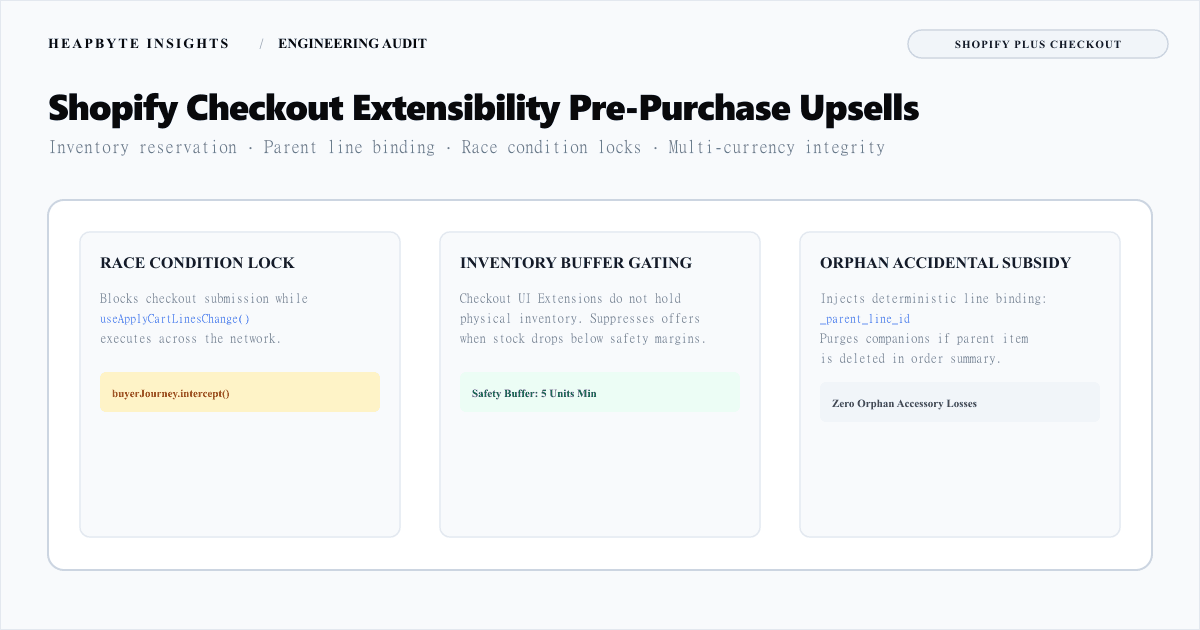
The mutation race condition: why asynchronous add-to-cart corrupts checkout state
The primary failure mode in custom checkout upsells stems from the asynchronous nature of Shopify's useApplyCartLinesChange hook.
When a buyer taps an upsell card's accept button, the extension dispatches an addCartLine mutation to the Shopify checkout API. This request leaves the web worker sandbox, travels over the network, recalculates cart taxes, validates shipping rates, and updates the checkout subtotal.
If the customer clicks 'Pay Now' or 'Complete Order' while this mutation is in-flight, Shopify's native checkout engine prioritises order completion over pending extension operations. If the mutation resolves after the checkout transition has entered its commit phase, the line addition is dropped silently. If the mutation completes halfway through payment tokenisation, the checkout reloads with an unhelpful 'Your cart has changed' warning, resetting payment fields and causing cart abandonment.
To prevent checkout collisions, the extension must subscribe to Shopify's useBuyerJourneyIntercept API. When the user initiates an upsell line addition, the extension immediately registers an intercept lock (canBlockProgress: true). Any attempt to click 'Complete Order' is gracefully held with an inline loading spinner until the cart mutation resolves, taxes re-calculate, and the checkout total confirms.
Zero inventory reservation: the out-of-stock payment barrier
In standard Shopify checkout, adding an item to the cart does not reserve physical warehouse inventory. Stock is deducted only when the final payment authorization succeeds.
This architectural reality creates a dangerous vulnerability for checkout upsells. High-converting upsell items are frequently promotional accessories or discounted bundles with limited stock. If an extension renders an upsell offer for a variant with only one unit remaining in inventory, that variant may be purchased by another customer on the storefront while your buyer is entering credit card details.
When your customer clicks 'Complete Order', Shopify evaluates inventory availability across all cart lines simultaneously. Because the companion accessory has sold out, the entire transaction fails at the payment gateway: (1) the customer sees an abrupt error banner, (2) checkout resets, stripping payment tokens, and (3) the merchant loses not just the upsell, but the primary high-ticket order.
Production-grade checkout extensions cannot rely on native checkout error reporting. The extension must enforce a defensive inventory buffer threshold. If real-time available inventory for the upsell SKU drops below a safe margin (e.g., fewer than five units), the extension automatically suppresses the offer card from the checkout sheet.
Orphaned companion lines: the parent deletion loophole
Pre-purchase checkout upsells are almost always conditional: a £120 mounting bracket is offered for £45 specifically because the customer is buying an £899 winch.
When the customer accepts the offer, the accessory is appended to the checkout as a discrete cart line. However, if the buyer subsequently opens the order summary accordion and deletes the primary winch, standard Shopify checkout does not understand that the accessory was contingent upon the parent.
The customer proceeds to complete checkout with a £45 mounting bracket that costs the merchant £62 to produce and £18 to ship, turning an intended high-margin bundle into an immediate commercial loss.
To prevent companion line abandonment, our architecture injects deterministic linkage properties into the line item payload (_parent_line_id, _upsell_offer_id, _bundle_role). A companion Cart & Checkout Validation Function continuously reconciles line item keys, automatically purging orphaned accessories if the parent line is deleted before payment commit.
import assert from "node:assert/strict";

export interface CartLine {
  id: string; // gid://shopify/CartLine/123
  merchandiseId: string; // gid://shopify/ProductVariant/456
  title: string;
  quantity: number;
  unitPriceCents: number;
  attributes: Record<string, string>;
}

export interface UpsellOfferDefinition {
  offerId: string;
  triggerVariantIds: string[];
  upsellVariantId: string;
  promotionalPriceCents: number;
  inventoryBufferRequired: number;
}

export interface InventoryStatus {
  availableQuantity: number;
  isInStock: boolean;
}

export class CheckoutUpsellCoordinator {
  private activeMutations = 0;

  constructor(
    private offers: UpsellOfferDefinition[],
    private inventoryCache: Record<string, InventoryStatus>
  ) {}

  public getEligibleOffers(cartLines: CartLine[]): UpsellOfferDefinition[] {
    const parentLineIds = new Set(cartLines.map(l => l.merchandiseId));
    return this.offers.filter(offer => {
      const hasTrigger = offer.triggerVariantIds.some(id => parentLineIds.has(id));
      if (!hasTrigger) return false;

      // Suppress if already present in cart
      const alreadyAdded = cartLines.some(
        l => l.merchandiseId === offer.upsellVariantId && l.attributes["_upsell_offer_id"] === offer.offerId
      );
      if (alreadyAdded) return false;

      // Defensive inventory threshold
      const inv = this.inventoryCache[offer.upsellVariantId];
      return inv && inv.availableQuantity >= offer.inventoryBufferRequired;
    });
  }

  public buildAddLinePayload(offer: UpsellOfferDefinition, parentLine: CartLine) {
    return {
      type: "addCartLine" as const,
      merchandiseId: offer.upsellVariantId,
      quantity: 1,
      attributes: {
        _parent_line_id: parentLine.id,
        _upsell_offer_id: offer.offerId,
        _bundle_pricing: "promotional_companion"
      }
    };
  }

  public detectOrphanedCompanions(cartLines: CartLine[]): CartLine[] {
    const activeLineIds = new Set(cartLines.map(l => l.id));
    return cartLines.filter(l => {
      const parentId = l.attributes["_parent_line_id"];
      return parentId && !activeLineIds.has(parentId);
    });
  }

  public beginMutation(): void { this.activeMutations++; }
  public completeMutation(): void { if (this.activeMutations > 0) this.activeMutations--; }

  public evaluateBuyerJourneyLock(): { canProceed: boolean; message?: string } {
    if (this.activeMutations > 0) {
      return { canProceed: false, message: "Updating cart options. Please wait..." };
    }
    return { canProceed: true };
  }
}Multi-currency rounding and fixed price snapshot integrity
Merchants scaling internationally on Shopify Plus encounter currency conversion anomalies inside Checkout Extensibility.
If your extension displays an upsell price calculated by multiplying a base GBP price by an external exchange rate, subtle rounding differences emerge. If your extension renders 'Add for €52.00', but Shopify's native Markets currency converter calculates the line item as €52.48, the customer notices the mismatch on the order summary, eroding buyer trust.
To maintain financial accuracy: (1) never calculate exchange rates client-side inside the extension sandbox, (2) read prices directly from Shopify's native cost and merchandise GraphQL objects provided by the extension runtime, and (3) if using fixed price lists in Shopify Markets, pass the exact currency code and minor units (cents) to ensure checkout line totals match promotional banners to the penny.
For stores running complex volume discounts alongside checkout offers, review our architecture for Shopify Function product discount rules and Shopify checkout custom calculations to prevent discount stacking collisions.
When this needs an engineer
You do not need a custom Checkout Extensibility upsell engine if you sell low-ticket goods with unlimited inventory, if your upsell items are full-priced catalogue variants without conditional subsidies, or if an off-the-shelf App Store widget handles your placement without checkout lag.
You need an engineer when your checkout operates under high financial or operational stakes: when upsell products carry heavy subsidies that must never be sold without their parent item; when real-time stock levels require defensive buffers to prevent out-of-stock checkout crashes; when mobile checkout speed demands zero mutation collisions via buyer journey intercept locks; and when multi-currency stores require exact penny-level price parity across international Markets.
Explore our engineering services in Shopify Plus development, inspect our custom applications case study collection, or review how checkout logic was delivered in the Forged 4x4 case study.
Send us your checkout teardown, upsell rules, and companion accessory catalogue. We will architect a Checkout UI Extension that maximises average order value while protecting checkout integrity.