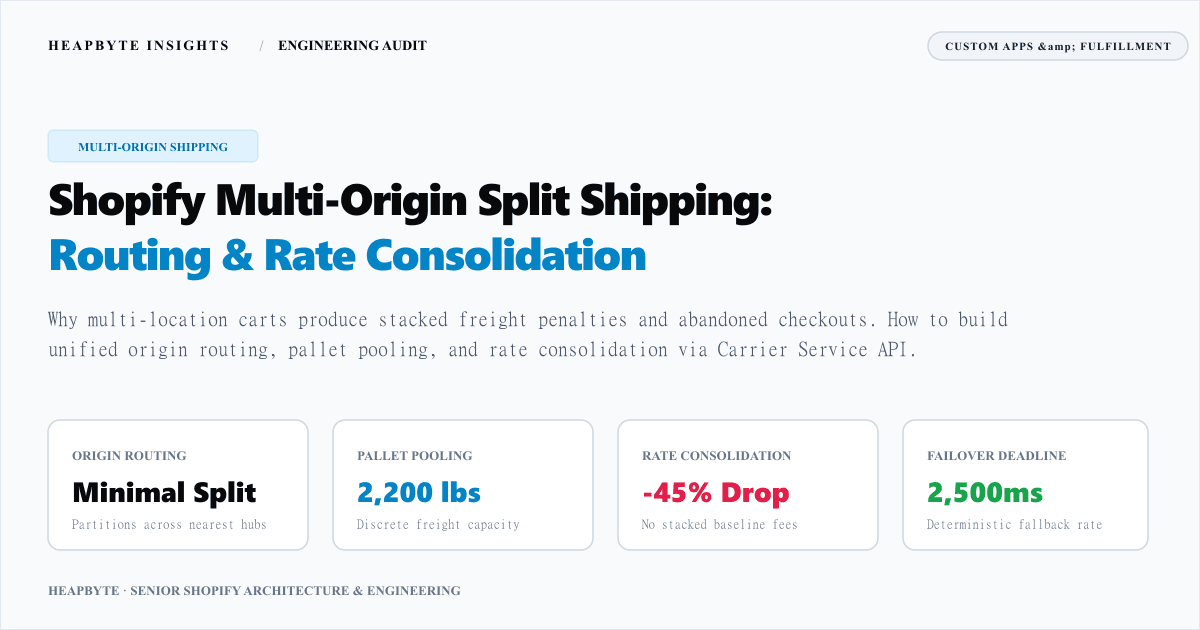
The stacked rate penalty: why naive multi-location profiles destroy conversion
When multiple fulfillment locations exist in Shopify Admin, Shopify determines fulfillment routing through Shipping Profiles.
If Product A is stocked exclusively at Location 1 and Product B is stocked exclusively at Location 2, adding both products to the cart forces Shopify into split-shipment mode.
The platform creates two distinct fulfillment packages: Package 1 from Location 1 ($340 with freight minimums and accessorials) and Package 2 from Location 2 ($340). When Shopify checkout presents the buyer with a combined shipping quote of $680, severe commercial friction occurs.
The failure lies in naive aggregation: residential neighborhood fees ($75) and hydraulic liftgate charges ($85) are duplicated for the same physical address, while Less-Than-Truckload (LTL) terminal minimum drop fees ($180 each) penalise the customer for the merchant's distributed inventory fragmentation.
In our custom shipping architecture for Online Stone Solutions (/work/online-stone-solutions) and complex checkout rules for Forged 4x4 (/work/forged-4x4-shopify-plus), we resolved this dilemma by intercepting shipping calculations within an external application layer before rates reach the customer checkout.
Single-origin sourcing vs consolidated split-dispatch economics
Before splitting an order into multiple packages, the routing engine must first evaluate whether a unified single-origin fulfillment is physically possible.
A customer may choose two items that are stocked locally at separate suburban depots, while a larger regional central distribution center 90 miles away stocks both SKUs in depth.
Standard Shopify shipping profiles cannot make this trade-off: they blindly route each line to the location designated as the default fulfillment priority, creating an artificial split shipment even when a single warehouse holds 100% of the requested inventory.
Dispatching from a slightly more distant single origin at an intra-zone freight tariff ($280/pallet) is almost universally cheaper than dispatching two separate local trucks paying duplicate minimum baseline drop charges ($180 × 2 = $360) plus double accessorials ($160). Only when no single location holds the required stock should the engine initiate multi-origin line partitioning.
export interface CartLineItem {
  variantId: string;
  sku: string;
  weightLbs: number;
  quantity: number;
  requiresFreight: boolean;
}

export interface FulfillmentOrigin {
  locationId: string;
  code: string;
  name: string;
  zone: string;
  inventoryBySku: Record<string, number>;
  baseHandlingFeeCents: number;
}

export interface DestinationAddress {
  postalCode: string;
  zone: string;
  isResidential: boolean;
  requiresLiftgate: boolean;
}

export const MAX_PALLET_WEIGHT_LBS = 2200;
export const RESIDENTIAL_SURCHARGE_CENTS = 7500; // $75.00
export const LIFTGATE_SURCHARGE_CENTS = 8500; // $85.00
export const MIN_LTL_DROP_CHARGE_CENTS = 18000; // $180.00 base drop

export function calculateConsolidatedMultiOriginRates(
  cart: CartLineItem[],
  origins: FulfillmentOrigin[],
  destination: DestinationAddress,
  options: { deadlineElapsedMs?: number; maxTimeoutMs?: number } = {}
) {
  // Defensive failover deadline guard
  if ((options.deadlineElapsedMs ?? 0) >= (options.maxTimeoutMs ?? 2500)) {
    const totalOrderWeightLbs = cart.reduce((acc, i) => acc + i.weightLbs * i.quantity, 0);
    const estimatedPallets = Math.max(1, Math.ceil(totalOrderWeightLbs / MAX_PALLET_WEIGHT_LBS));
    const fallbackRateCents = estimatedPallets * 35000;
    return { isSplitShipment: true, consolidatedRateCents: fallbackRateCents, isFallbackRate: true };
  }

  // 1. Single-Origin Feasibility Check
  const singleOrigin = origins.find(origin => cart.every(i => (origin.inventoryBySku[i.sku] ?? 0) >= i.quantity));
  if (singleOrigin) {
    const totalWeight = cart.reduce((acc, i) => acc + i.weightLbs * i.quantity, 0);
    const pallets = Math.max(1, Math.ceil(totalWeight / MAX_PALLET_WEIGHT_LBS));
    const ratePerPallet = singleOrigin.zone === destination.zone ? 18000 : 28000;
    const baseLinehaul = pallets * ratePerPallet + singleOrigin.baseHandlingFeeCents;
    const accessorials = (destination.isResidential ? RESIDENTIAL_SURCHARGE_CENTS : 0) + (destination.requiresLiftgate ? LIFTGATE_SURCHARGE_CENTS : 0);
    return { isSplitShipment: false, consolidatedRateCents: baseLinehaul + accessorials, isFallbackRate: false };
  }

  // 2. Greedy Multi-Origin Partitioning
  const remaining = Object.fromEntries(cart.map(i => [i.sku, i.quantity]));
  const sortedOrigins = [...origins].sort((a, b) => (a.zone === destination.zone ? -1 : 1));
  const packages: Array<{ origin: FulfillmentOrigin; weight: number; pallets: number; linehaul: number }> = [];

  for (const origin of sortedOrigins) {
    let pkgWeight = 0;
    for (const item of cart) {
      const needed = remaining[item.sku] ?? 0;
      if (needed <= 0) continue;
      const available = origin.inventoryBySku[item.sku] ?? 0;
      if (available <= 0) continue;
      const take = Math.min(needed, available);
      remaining[item.sku] -= take;
      pkgWeight += take * item.weightLbs;
    }
    if (pkgWeight > 0) {
      const pallets = Math.max(1, Math.ceil(pkgWeight / MAX_PALLET_WEIGHT_LBS));
      const ratePerPallet = origin.zone === destination.zone ? 18000 : 28000;
      packages.push({ origin, weight: pkgWeight, pallets, linehaul: pallets * ratePerPallet + origin.baseHandlingFeeCents });
    }
  }

  // 3. Rate Consolidation: Absorb secondary drop fee & apply accessorials once
  const rawLinehaulSum = packages.reduce((acc, p) => acc + p.linehaul, 0);
  const consolidationDiscount = packages.length > 1 ? Math.round(MIN_LTL_DROP_CHARGE_CENTS * 0.45) : 0;
  const accessorials = (destination.isResidential ? RESIDENTIAL_SURCHARGE_CENTS : 0) + (destination.requiresLiftgate ? LIFTGATE_SURCHARGE_CENTS : 0);

  return {
    isSplitShipment: packages.length > 1,
    consolidatedRateCents: rawLinehaulSum - consolidationDiscount + accessorials,
    breakdown: { baseLinehaulCents: rawLinehaulSum, multiOriginConsolidationDiscountCents: consolidationDiscount },
    isFallbackRate: false
  };
}Pallet density pooling and multi-origin Carrier Service API callbacks
In standard parcel ecommerce, shipping calculates by billable dimensional weight. In heavy industrial, agricultural, and landscape materials, orders weigh out before they cube out.
A standard 48×40-inch wooden pallet has an industry safe working load limit (WLL) of approximately 2,200 lbs (1 metric ton). If a customer orders 5,500 lbs of stone slabs, that load cannot be compressed into two pallets: it physically requires three discrete pallets.
When an order is partitioned across multiple origins, the calculation engine pools weight on a per-origin basis. It formats the consolidated freight charge and returns a single, unified service rate via the Carrier Service API callback.
By returning a single unified service rate rather than exposing multiple raw packages, the customer cart renders one professional delivery option. For Plus merchants seeking to conditionally reorder or hide delivery methods based on PO boxes or hazardous materials, consult our guide on Shopify delivery customization shipping rules (/insights/shopify-delivery-customization-shipping-rules).
Defensive 2,500ms deadlines and deterministic fallback routing
The most unforgiving operational constraint in custom shipping engineering is Shopify's Carrier Service API timeout architecture.
Shopify permits a maximum callback window of 10,000ms. If your webhook does not return valid JSON within that window, Shopify aborts the request entirely. However, relying on the full 10-second window is fatal: mobile shoppers abandon carts if the checkout shipping spinner persists beyond 3 seconds.
To guarantee zero checkout freezes, our routing architecture enforces an internal 2,500ms circuit breaker: querying warehouse inventory and carrier tariff tables concurrently, aborting external polling if the deadline expires, and instantly emitting a conservative deterministic fallback rate ($350 floor per pallet) with operational review flags.
The checkout never fails, the customer completes their purchase, and fulfillment staff receive an automated administrative notification to review the carrier dispatch manifest before trucks roll. If your freight involves flatbed offloading or accessorial equipment, review our architecture for custom shipping rate calculations and LTL freight palletization (/insights/shopify-custom-shipping-rate-calculation).
When this needs an engineer
You do not need a custom multi-origin split shipping engine if you ship lightweight parcel goods from a single fulfillment center, if your 3PL manages all inventory allocation behind a single unified API, or if your products can ship via standard flat-rate carrier tables.
You need an engineer when your catalog is geographically fragmented: when products ship from regional quarries, distributed warehouses, or specialized manufacturer plants; when standard Shopify shipping profiles stack multiple baseline freight drop fees into exorbitant quotes; when multi-origin orders must evaluate single-origin sourcing feasibility; when accessorial charges like hydraulic liftgate delivery must be billed once per destination rather than duplicated per origin; and when carrier API latency must be bounded by defensive failover deadlines to protect checkout conversion.
Explore our engineering services in custom Shopify application development (/services/custom-shopify-apps), inspect our custom applications case study collection (/work/collections/custom-applications), or review how complex shipping logic was delivered in the Online Stone Solutions case study (/work/online-stone-solutions).
Send us your fulfillment locations, inventory distribution model, and carrier rate structure. We will architect a high-performance shipping consolidation engine that protects your margins, eliminates checkout penalties, and keeps your conversion rock solid.