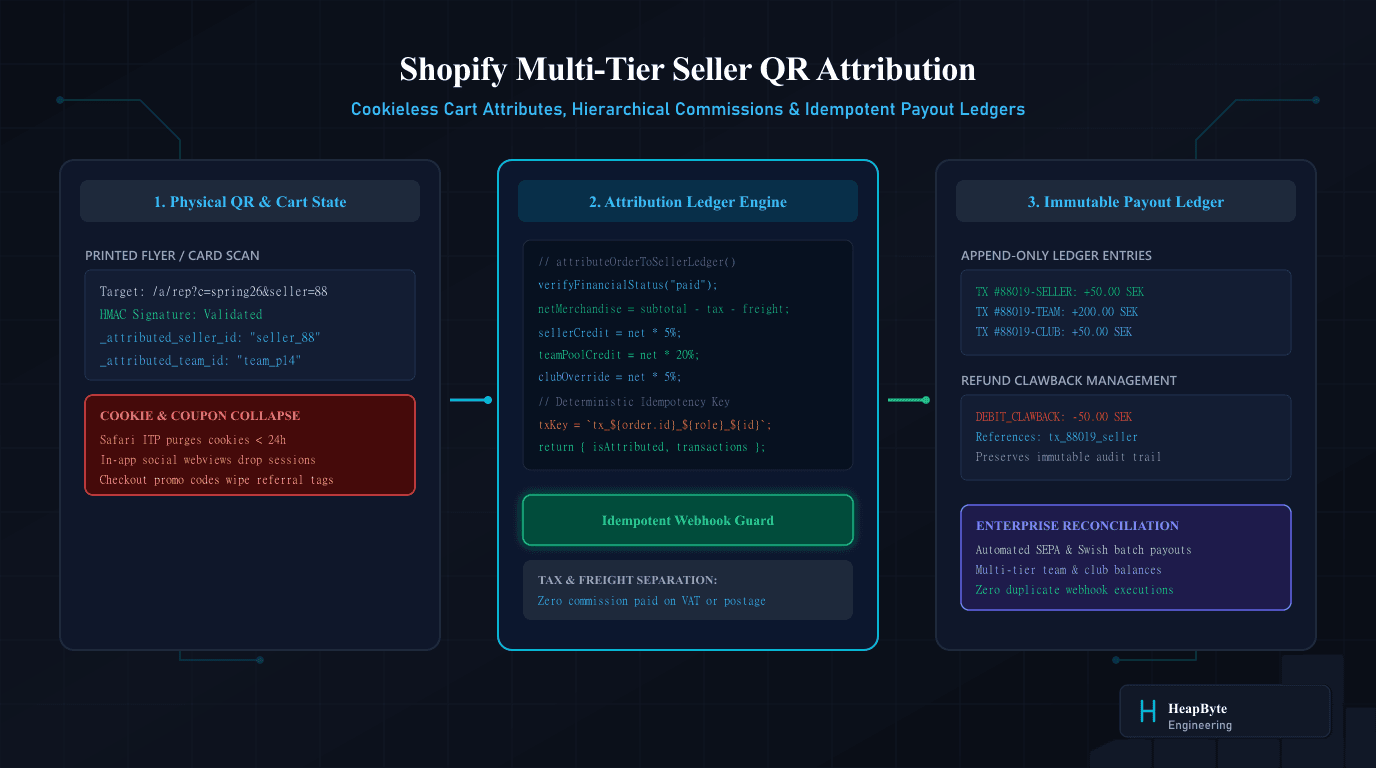
The failure of cookie-based tracking and coupon codes
Most affiliate and influencer apps on the Shopify App Store rely on two architectural mechanisms: URL query parameters that write first-party or third-party browser cookies, and vanity discount codes. In field sales and distributed fundraising, both mechanisms fail systematically.
First, mobile privacy mechanisms actively destroy cookie continuity. Under Apple's WebKit Intelligent Tracking Prevention (ITP), script-writable storage (including document.cookie and localStorage) is capped at seven days or purged within twenty-four hours if the referral URL carries query parameters. When a customer scans a physical QR code inside an in-app browser—such as WhatsApp, Instagram, or WeChat—the browsing session executes in an isolated sandbox. If the buyer subsequently switches to native Safari or Chrome to complete their payment via Apple Pay, the session cookie is discarded entirely.
Second, coupon code attribution creates checkout friction. While Shopify now supports multiple discount codes, apps historically bound commission attribution to the presence of a specific discount code. If a shopper applies a sitewide promotional code or a free-shipping voucher that conflicts with the seller's code, the seller code is removed, silently erasing the attribution link.
Relying on discount codes also forces merchants to surrender margin simply to record an attribution event. If your business model rewards sellers with commission or team fundraising profits, discounting the customer's purchase is commercially backwards.
Deterministic QR routing via signed cart attributes
To achieve deterministic attribution across mobile devices, the tracking data must be bound directly to the server-side Shopify Cart object.
Instead of directing QR scans to generic product URLs carrying loose tracking tags, each printed QR code encodes a signed destination URL routed through an application proxy or lightweight edge worker.
When the user scans the QR code, the application proxy verifies the HMAC signature to prevent forged seller tokens, then writes explicit underscore-prefixed cart attributes via /cart/update.js (_attributed_seller_id, _attributed_team_id, _attributed_club_id, _campaign_id).
Because cart attributes are stored on Shopify's persistent Cart entity, they survive browser restarts, device orientation changes, and checkout transitions. When the customer completes checkout, Shopify immutably copies these cart attributes to the resulting Order resource under customAttributes and note_attributes.
The organizational hierarchy: clubs, teams, and sellers
Unlike single-tier influencer programs where an individual receives a flat commission, sports leagues, school districts, and direct sales networks operate within hierarchical organisations: clubs, teams, and individual sellers.
When an order arrives, the attribution engine must distribute commercial proceeds across multiple levels of the hierarchy. A single €100 sale might generate €20 for the team's upcoming tournament travel fund, €5 for the club's facility maintenance, and €5 in individual performance credits for the youth seller.
Shopify's Customer and Staff accounts cannot represent this multi-tier tree. Trying to stuff club and team memberships into customer tags creates race conditions and parse failures. The structural hierarchy must reside in an external database, indexed by unique seller tokens.
Pure attribution logic: from order payload to ledger credit
When Shopify emits an orders/paid webhook, the ingestion engine evaluates line items, excludes freight and value-added tax, verifies the cryptographic signature, and computes immutable ledger credits:
export interface OrderLineItem {
  id: string;
  sku: string;
  title: string;
  quantity: number;
  price: string; // unit price
  totalDiscount: string;
  taxable: boolean;
}

export interface ShopifyOrderPayload {
  id: string;
  orderNumber: number;
  currency: string;
  totalPrice: string;
  totalTax: string;
  totalShipping: string;
  lineItems: OrderLineItem[];
  customAttributes: Array<{ name: string; value: string }>;
  financialStatus: "paid" | "partially_paid" | "refunded" | "voided";
}

export interface HierarchyCommissionRule {
  campaignId: string;
  sellerCommissionPercent: number; // e.g., 5%
  teamCommissionPercent: number; // e.g., 20%
  clubCommissionPercent: number; // e.g., 5%
  minQualifyingSubtotal?: number;
}

export interface LedgerTransactionEntry {
  transactionId: string; // Idempotent hash key
  orderId: string;
  beneficiaryId: string;
  beneficiaryRole: "SELLER" | "TEAM" | "CLUB";
  currency: string;
  amount: number;
  type: "CREDIT" | "DEBIT_CLAWBACK";
  reason: string;
  createdAt: string;
}

export interface AttributionEvaluationResult {
  orderId: string;
  isAttributed: boolean;
  campaignId?: string;
  sellerId?: string;
  teamId?: string;
  clubId?: string;
  qualifyingNetSubtotal: number;
  transactions: LedgerTransactionEntry[];
  errors: string[];
}

export function attributeOrderToSellerLedger(params: {
  order: ShopifyOrderPayload;
  rule: HierarchyCommissionRule;
  existingTransactionIds: Set<string>;
}): AttributionEvaluationResult {
  const { order, rule, existingTransactionIds } = params;
  const errors: string[] = [];
  const transactions: LedgerTransactionEntry[] = [];

  // 1. Extract and validate cart attributes
  const attrMap = new Map<string, string>();
  for (const attr of order.customAttributes) {
    attrMap.set(attr.name, attr.value);
  }

  const sellerId = attrMap.get("_attributed_seller_id");
  const teamId = attrMap.get("_attributed_team_id");
  const clubId = attrMap.get("_attributed_club_id");
  const campaignId = attrMap.get("_campaign_id");

  if (!sellerId || !teamId || !clubId) {
    return {
      orderId: order.id,
      isAttributed: false,
      qualifyingNetSubtotal: 0,
      transactions: [],
      errors: ["Missing required attribution attributes on order."],
    };
  }

  if (campaignId !== rule.campaignId) {
    errors.push(`Campaign mismatch: order has "${campaignId}", rule expects "${rule.campaignId}".`);
  }

  if (order.financialStatus !== "paid") {
    errors.push(`Order financial status "${order.financialStatus}" is not eligible for commission credit.`);
  }

  // 2. Calculate tax-exclusive, freight-free net merchandise subtotal
  let netSubtotal = 0;
  for (const line of order.lineItems) {
    const lineTotal = parseFloat(line.price) * line.quantity;
    const discount = parseFloat(line.totalDiscount || "0");
    netSubtotal += Math.max(0, lineTotal - discount);
  }

  if (rule.minQualifyingSubtotal && netSubtotal < rule.minQualifyingSubtotal) {
    errors.push(`Order net subtotal (${netSubtotal.toFixed(2)}) below minimum threshold (${rule.minQualifyingSubtotal}).`);
  }

  if (errors.length > 0) {
    return {
      orderId: order.id,
      isAttributed: false,
      campaignId,
      sellerId,
      teamId,
      clubId,
      qualifyingNetSubtotal: netSubtotal,
      transactions: [],
      errors,
    };
  }

  // 3. Emit immutable ledger entries with deterministic idempotency keys
  const beneficiaryConfigs = [
    { id: sellerId, role: "SELLER" as const, percent: rule.sellerCommissionPercent },
    { id: teamId, role: "TEAM" as const, percent: rule.teamCommissionPercent },
    { id: clubId, role: "CLUB" as const, percent: rule.clubCommissionPercent },
  ];

  for (const beneficiary of beneficiaryConfigs) {
    if (beneficiary.percent <= 0) continue;

    const commissionAmount = Math.round(netSubtotal * (beneficiary.percent / 100) * 100) / 100;
    const transactionId = `tx_${order.id}_${beneficiary.role.toLowerCase()}_${beneficiary.id}`;

    if (existingTransactionIds.has(transactionId)) {
      errors.push(`Duplicate transaction detected for key "${transactionId}". Skipped.`);
      continue;
    }

    transactions.push({
      transactionId,
      orderId: order.id,
      beneficiaryId: beneficiary.id,
      beneficiaryRole: beneficiary.role,
      currency: order.currency.toUpperCase(),
      amount: commissionAmount,
      type: "CREDIT",
      reason: `Order #${order.orderNumber} ${beneficiary.role.toLowerCase()} commission (${beneficiary.percent}% on ${netSubtotal.toFixed(2)})`,
      createdAt: new Date().toISOString(),
    });
  }

  return {
    orderId: order.id,
    isAttributed: true,
    campaignId,
    sellerId,
    teamId,
    clubId,
    qualifyingNetSubtotal: netSubtotal,
    transactions,
    errors,
  };
}Idempotency, returns, and refund clawbacks
In financial accounting, you do not update a transaction row in place. If an order is modified, cancelled, or returned, mutating historical earnings rows destroys the audit trail.
As explored in our architecture guide on Shopify payout ledger architecture, resilient commission systems run on append-only event sourcing:
1. Webhook Idempotency: Shopify webhook deliveries guarantee at-least-once delivery. Network timeouts frequently cause Shopify to retransmit the exact same orders/paid event minutes later. By deriving the transaction ID deterministically from tx_${order.id}_${role}_${beneficiaryId}, duplicate webhooks are rejected by database primary key constraints without corrupting balances.
2. Refund Clawbacks: When a customer returns goods or disputes a charge, Shopify fires refunds/create. The engine calculates the refunded proportion of the net merchandise subtotal and posts an explicit DEBIT_CLAWBACK transaction pointing to the original transaction ID.
3. Negative Balance Caps: If a seller or team has already withdrawn their campaign proceeds before a return occurs, their ledger balance transitions to a monitored negative position, deducting automatically from future campaign cycles rather than causing unrecoverable cash leaks.
What native Shopify seller tracking cannot do
Standard Shopify features and marketplace affiliate apps fail at several architectural boundaries:
- Cannot maintain multi-tier organisational trees: Shopify has no native data structure for multi-level hierarchical entities (Association -> Club -> Team -> Seller). Storing relationships in customer tags or metaobjects creates concurrency bottlenecks during mass fundraising campaigns.
- Cannot protect attribution against coupon code overwrites: Standard checkout coupon inputs cannot natively distinguish between promotional discounts and affiliate tracking codes, frequently allowing buyer-entered vouchers to clear seller attribution.
- Cannot automate bulk vector QR generation: Standard admin tools cannot generate eighteen thousand cryptographically signed, vector-optimised SVG or PDF QR codes formatted for commercial print houses.
- Cannot execute batch SEPA or Swish payouts: Shopify Payouts pays the store owner, not third-party sellers. Disbursing commissions to thousands of minor participants or regional clubs requires external bank integration adhering to local tax reporting laws.
When this needs an engineer
You do not need a custom engineering build if you are managing ten brand ambassadors who share promotional discount codes on social media. In that scenario, off-the-shelf affiliate apps like UpPromote or Collabs handle tracking and PayPal payouts reliably.
You need an engineer when your attribution model supports offline field networks: when thousands of sports teams, field reps, or students sell products via physical QR codes, when attribution must distribute earnings across multiple organisational tiers, when privacy protections break standard browser cookies, and when payouts must reconcile through an immutable, audit-ready financial ledger.
Explore our custom Shopify applications case studies to see how brands deploy dedicated operational platforms, or inspect the Säsongsgruppen seller QR platform case study to see how thousands of team sellers were managed during peak campaigns. You can also explore our custom Shopify app development services. Send us the store and the symptom.