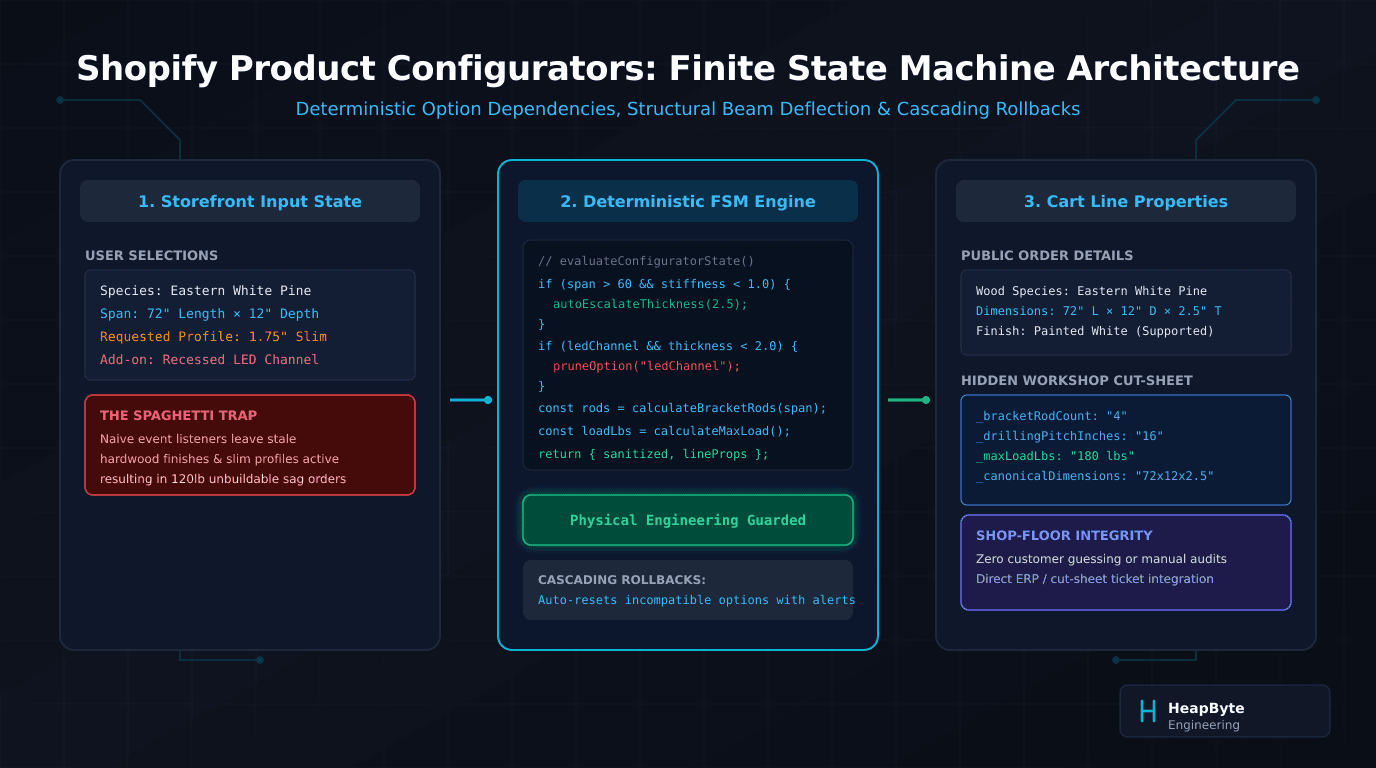
The failure of ad-hoc event listeners
The standard lifecycle of a Shopify configurator begins simply. A merchant adds a custom script where changing a 'Material' dropdown updates a 'Finish' dropdown using basic conditions.
Within months, customisation expands. Customers can specify fractional lengths, deeper profiles, heavy-duty hardware for masonry walls, and integrated LED accent lighting. Hardwood species like Maple and Walnut resist bending deflection under load; softwoods like Pine sag unless supported by additional steel bracket rods or thicker profiles.
When conditional logic is distributed across independent DOM listeners, three failure modes emerge: stale option retention, where hidden options remain checked in the DOM; event listener race conditions during asynchronous recalculations; and silent manufacturing rejects where unbuildable orders are accepted into checkout.
Why Shopify variants cannot represent dependent options
The common question from teams unfamiliar with bespoke manufacturing is: 'Why not create variants for each valid combination?'
The platform mathematics make this impossible. In our work rebuilding Custom Floating Shelves, the catalogue spanned 18 wood species, lengths from 12 to 96 inches, depths from 6 to 16 inches, 3 profile thicknesses, 5 finishes, and 4 mounting types. Even with lengths stepped in discrete six-inch intervals, combinations exceed 350,000 permutations.
While Shopify raised the per-product variant limit from 100 to 2,048 in October 2025, the platform never raised the three-option limit. A Shopify product cannot natively carry more than three option dimensions (such as Species, Size, Finish). A fourth option—such as Mounting Hardware or LED Preparation—cannot exist within the variant model. Continuous dimensional products belong in application state, where options are captured as line item properties and validated before submission.
The finite state machine pattern for bespoke configurators
A robust configurator models configuration not as isolated dropdowns, but as an immutable finite state machine (FSM). Whenever any input changes, the configuration passes through a pure validation pipeline that clamps continuous dimensions, derives structural hardware, enforces deflection constraints, cascades option rollbacks, and formats clean workshop cut-sheets.
export type WoodSpecies = "walnut" | "oak" | "maple" | "pine" | "alder";
export type ShelfFinish = "natural_oil" | "clear_matte" | "dark_walnut_stain" | "unfinished" | "painted_white";
export type WallType = "drywall_studs_16" | "drywall_studs_24" | "solid_masonry" | "drywall_no_studs";

export interface ConfiguratorInput {
  species: WoodSpecies;
  lengthInches: number; // 12 to 96
  depthInches: number;  // 6 to 16
  thicknessInches: number; // 1.75, 2.0, 2.5
  finish: ShelfFinish;
  wallType: WallType;
  ledChannel: boolean;
}

const SPECIES_STIFFNESS_FACTORS: Record<WoodSpecies, number> = {
  maple: 1.2,
  walnut: 1.0,
  oak: 1.05,
  alder: 0.75,
  pine: 0.7,
};

const SPECIES_ALLOWED_FINISHES: Record<WoodSpecies, ShelfFinish[]> = {
  walnut: ["natural_oil", "clear_matte", "unfinished"],
  oak: ["natural_oil", "clear_matte", "dark_walnut_stain", "unfinished"],
  maple: ["natural_oil", "clear_matte", "unfinished"],
  alder: ["clear_matte", "dark_walnut_stain", "painted_white", "unfinished"],
  pine: ["dark_walnut_stain", "painted_white", "unfinished"],
};

export function evaluateConfiguratorState(rawInput: ConfiguratorInput) {
  const warnings: string[] = [];
  const errors: string[] = [];

  // 1. Clamp dimensions to physical manufacturing limits
  const lengthInches = Math.max(12, Math.min(96, Math.round(rawInput.lengthInches * 100) / 100));
  const depthInches = Math.max(6, Math.min(16, Math.round(rawInput.depthInches * 100) / 100));

  // 2. Wall mounting and bracket pitch validation
  if (rawInput.wallType === "drywall_no_studs") {
    errors.push("Floating shelves require solid masonry or wood stud anchoring. Hollow drywall anchors are prohibited.");
  }
  const pitch = rawInput.wallType === "drywall_studs_24" ? 24 : 16;
  const spans = lengthInches <= 32 ? 1 : Math.floor((lengthInches - 16) / pitch);
  const bracketRodCount = Math.max(2, spans + 1);

  // 3. Minimum thickness enforcement for deflection limits
  const stiffness = SPECIES_STIFFNESS_FACTORS[rawInput.species] ?? 1.0;
  let minThickness = 1.75;
  if (lengthInches > 60) {
    minThickness = stiffness >= 1.1 ? 2.0 : 2.5;
  } else if (lengthInches > 36) {
    minThickness = stiffness >= 1.0 ? 1.75 : 2.0;
  }

  let thicknessInches = rawInput.thicknessInches;
  if (thicknessInches < minThickness) {
    warnings.push(`Adjusted thickness from ${thicknessInches}" to minimum safe ${minThickness}" for ${lengthInches}" ${rawInput.species} span.`);
    thicknessInches = minThickness;
  }

  // 4. LED lighting channel geometry constraints
  let ledChannel = rawInput.ledChannel;
  if (ledChannel) {
    if (depthInches < 8) {
      warnings.push('Recessed LED channel requires minimum 8" depth to clear internal bracket rods. LED option removed.');
      ledChannel = false;
    } else if (thicknessInches < 2.0) {
      warnings.push('Recessed LED channel requires minimum 2.0" thickness to maintain structural core. LED option removed.');
      ledChannel = false;
    }
  }

  // 5. Wood species and finish dependency cascading
  let finish = rawInput.finish;
  const allowed = SPECIES_ALLOWED_FINISHES[rawInput.species];
  if (!allowed.includes(finish)) {
    warnings.push(`Finish "${finish}" is unavailable on ${rawInput.species}. Automatically switched to "${allowed[0]}".`);
    finish = allowed[0];
  }

  // 6. Safe load calculation based on beam deflection
  const lengthFeet = lengthInches / 12;
  const beamDeflectionCapacity = (Math.pow(thicknessInches, 2.5) / Math.pow(lengthFeet, 1.8)) * (depthInches / 10) * 120 * stiffness;
  const maxDeflectionLoadLbs = Math.min(bracketRodCount * 45, Math.round(beamDeflectionCapacity / 5) * 5);

  // 7. Format clean Shopify Line Item Properties
  const lineItemProperties: Record<string, string> = {
    "Wood Species": rawInput.species.charAt(0).toUpperCase() + rawInput.species.slice(1),
    "Dimensions": `${lengthInches}" L × ${depthInches}" D × ${thicknessInches}" T`,
    "Finish": finish.replace(/_/g, " ").replace(/\b\w/g, c => c.toUpperCase()),
    "Wall Mounting": rawInput.wallType.replace(/_/g, " "),
    "_bracketRodCount": String(bracketRodCount),
    "_drillingPitchInches": String(pitch),
    "_maxLoadLbs": `${maxDeflectionLoadLbs} lbs`,
    "_ledChannelPrepared": ledChannel ? "true" : "false",
    "_canonicalDimensions": `${lengthInches}x${depthInches}x${thicknessInches}`,
  };

  return {
    isValid: errors.length === 0,
    sanitizedConfig: { species: rawInput.species, lengthInches, depthInches, thicknessInches, finish, wallType: rawInput.wallType, ledChannel },
    manufacturingSpecs: { bracketRodCount, drillingPitchInches: pitch, minRequiredThicknessInches: minThickness, maxDeflectionLoadLbs },
    lineItemProperties,
    warnings,
    errors,
  };
}Evaluating structural span deflection and bracket pitch
In bespoke furniture, dimensions dictate mounting hardware. Standard residential construction in North America uses 16-inch stud spacing (with 24-inch in specific commercial partitions). For a 48-inch shelf mounted to 16-inch studs, the engine calculates three bracket rods spaced exactly 16 inches on centre, giving an even 8-inch cantilever on each end.
Beam deflection formulas calculate safe load capacity. A deep 14-inch shelf spanning 72 inches exerts substantial leverage on wall anchors. By calculating safe deflection load—capping the rating at either anchor pull-out limits or wood bending limits—the configurator sets realistic expectations before purchase. This rating (_maxLoadLbs) travels with the order directly into workshop cut-sheets.
Cascading rollbacks: keeping downstream options consistent
The core UX challenge of complex configurators is handling user backtracking. A user configures a shelf, selects options across six steps, and then toggles an option in step one.
Developers frequently fall into two traps: the Stale Value Trap, where upstream changes leave invalid downstream selections checked, and the Frustration Trap, where resetting all fields forces the customer to start over from scratch.
The Deterministic FSM Pattern evaluates downstream choices against updated constraints. If a downstream choice remains valid, it is preserved. If it is now invalid (such as a painted finish on Walnut, or a 1.75-inch thickness on a 72-inch Pine span), the engine rolls it back to the nearest safe default, updates the controls, and displays an informative banner. The user understands why their selection adjusted without restarting the workflow.
Emitting workshop cut-sheets via line item properties
Once the configuration passes validation, state hands over to Shopify via /cart/add.js.
Customer-facing choices pass as standard line item properties (Wood Species, Dimensions, Finish). Workshop manufacturing parameters pass using underscore-prefixed keys (_bracketRodCount, _drillingPitchInches, _canonicalDimensions, _maxLoadLbs).
Shopify natively hides underscore-prefixed properties from customer-facing checkout screens, cart drawers, and email receipts. However, these properties remain accessible in Order Admin and via the GraphQL Admin API. When your ERP or ticketing application reads the order, drilling pitch and hardware specifications are ready for production without manual transcription.
This matches the pattern in our made-to-measure curtain pricing engine, where atelier cut-sheets and fullness parameters attach directly to order lines.
What frontend configurator state machines cannot do
Understanding platform boundaries prevents architectural failures when designing bespoke configurators:
- Cannot guarantee server-side pricing authority: A client-side machine computes display prices, but users can alter browser JavaScript variables. True protection requires signing calculated prices with HMAC tokens or verifying them via Cart Transform functions, as detailed in our guide to [computed price authority on Shopify](/insights/computed-price-authority-shopify).
- Cannot bypass Shopify's 100-line cart limit: If a configurator decomposes a single product into multiple physical cart lines (e.g. shelf + hardware kit + LED power supply), it consumes cart line capacity.
- Cannot check live raw material inventory without network queries: State machines validate business rules, but confirming whether a specific timber slab is in stock requires background inventory lookups.
When this needs an engineer
You do not need a custom state machine if you sell products with independent options—such as a t-shirt in three colours and four sizes. Shopify's standard variants handle simple orthogonal choices adequately.
You need an engineer when your products involve physical engineering constraints: where timber species governs profile thickness, dimensions dictate structural mounting hardware, finishes are restricted by base materials, and downstream choices must cascade cleanly without generating impossible manufacturing orders.
Explore our custom product configurators collection to see how we build made-to-order experiences, or consult our Shopify configurator development services. Send us the store and the symptom.