Case study · 2026
Custom Floating Shelves
A shelving catalog too complex for ordinary Shopify variants became a configurable, scalable ordering system.
- Shopify Online Store 2.0
- Liquid
- JavaScript
- Shopify Admin API
- Discipline
- Custom product configurator · Dynamic pricing · Shopify migration · UX
- Year
- 2026
- Engagement
- Fixed scope
- Status
- Live
01Context
- Expand the custom configurator across multiple shelf and product types.
- Consolidate the legacy catalog into a maintainable Shopify architecture.
- Preserve pricing accuracy, checkout behavior, SEO URLs, and customer workflows through launch.
Custom Floating Shelves sells made-to-order wood shelving where pricing depends on material, width, depth, thickness, finish, hardware, and optional preparation work. Standard Shopify variants could not represent the catalog cleanly.
The store also carried years of legacy pages, calculator-driven products, overlapping URLs, and product structures that made ongoing maintenance increasingly difficult.
HeapByte was brought in to expand the existing configurator, consolidate the storefront, migrate away from the older calculator structure, and take the rebuilt system live without breaking the ordering experience or SEO footprint.
02What was in the way
- 01
Pricing beyond variants
Dimensions, materials, thickness, finish, hardware, and add-ons all affected price. The number of combinations made a traditional Shopify variant model impractical.
- 02
Consolidating years of catalog growth
The existing site contained overlapping product and collection structures accumulated over several years. Consolidation had to preserve useful ranking URLs and redirect obsolete ones safely.
- 03
Real-world edge cases
Fractional dimensions, material-specific restrictions, corner geometry, lighting preparation, samples, quick-ship products, and cart breakdowns all had different business rules.
03Architecture
What we built, and what we deliberately left alone.
- 01
Database-driven configurator
Pricing and configuration rules were separated from ordinary Shopify variant pricing so complex dimensions and material combinations could be calculated dynamically.
- 02
Consolidated material pages
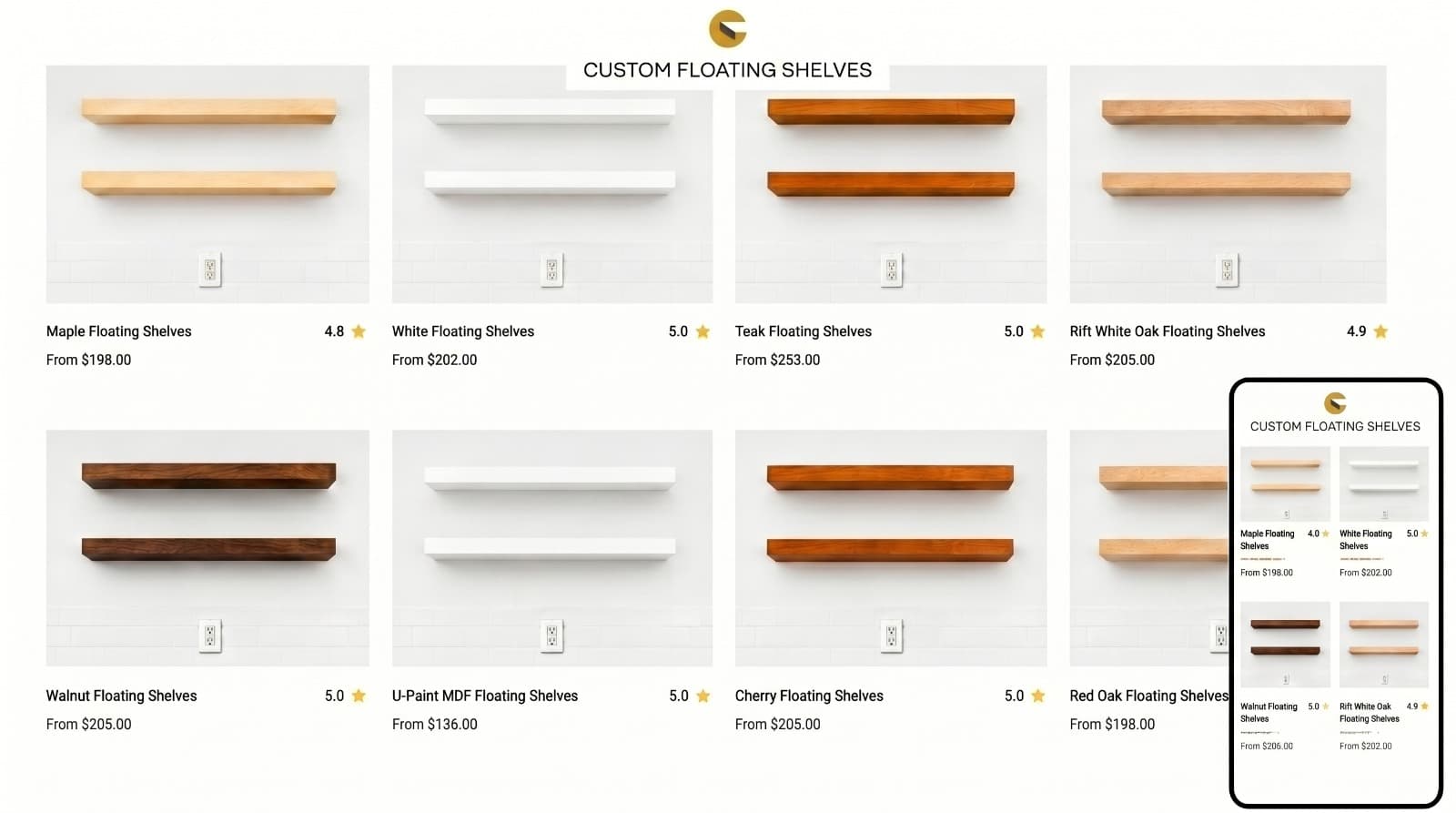
Each material page was redesigned around multiple product types including floating shelves, slabs, closet shelves, corners, and wall hook racks.
- 03
Shopify-native cart handoff
Configured products and paid add-ons were transformed into clear Shopify cart line items so customers could complete checkout through the standard commerce flow.
Delivery
- Configurator expansion
- Product architecture consolidation
- Quick Ship, samples & add-ons
- SEO migration & redirects
- Launch & post-launch QA
04Outcome
- Product families
- 5 per material page
- Material catalog
- 18 materials
- Legacy redirects
- ~195
- Store status
- Live
Floating shelf, slab, closet shelf, corner shelf and wall hook rack
Consolidated into a standardized product architecture
Product and collection redirects prepared for the migration
Core ordering flow launched and processed real customer orders
05Engineering notes
- Fractional dimensions
- The configurator supports dimensional ranges and fractional measurements while preserving consistent pricing lookup and cart representation.
- Material gating
- Availability of finishes, product types, and options is controlled by material-specific rules rather than duplicated templates.
- Configurable galleries
- Lower product sections use dedicated Shopify metafields while the primary floating-shelf section uses native product media.
- Cart decomposition
- Base products and applicable add-ons can appear as separate priced lines, improving transparency while preserving configuration context.
What we took from it
- 01Complex made-to-order products need a pricing model separate from Shopify variants.
- 02Catalog consolidation is as much an SEO project as a development project.
- 03Customer-facing configurators need defensive handling for every combination edge case.
- 04Post-launch order data is the fastest way to expose assumptions that staging never reveals.
Disciplines applied
Written up
Engineering
Twenty-three and three-eighths is one size, not five
Architecture
A sample is a product nobody should find
Migration
Shopify protects renames, not deletions
Engineering
Custom price per cart item on Shopify: where price authority actually lives
Architecture
Pricing by dimensions: when Shopify variants are the wrong model
Next case study
Weldaad Supplier Portal
We built a custom Shopify-connected supplier portal for purchase orders, product submissions, approvals, supplier collaboration, and structured product synchronization.
Similar problem?
We will tell you whether this approach fits.
Every store is different. Send us yours and we will say what we would actually do — including when the answer is less work, not more.