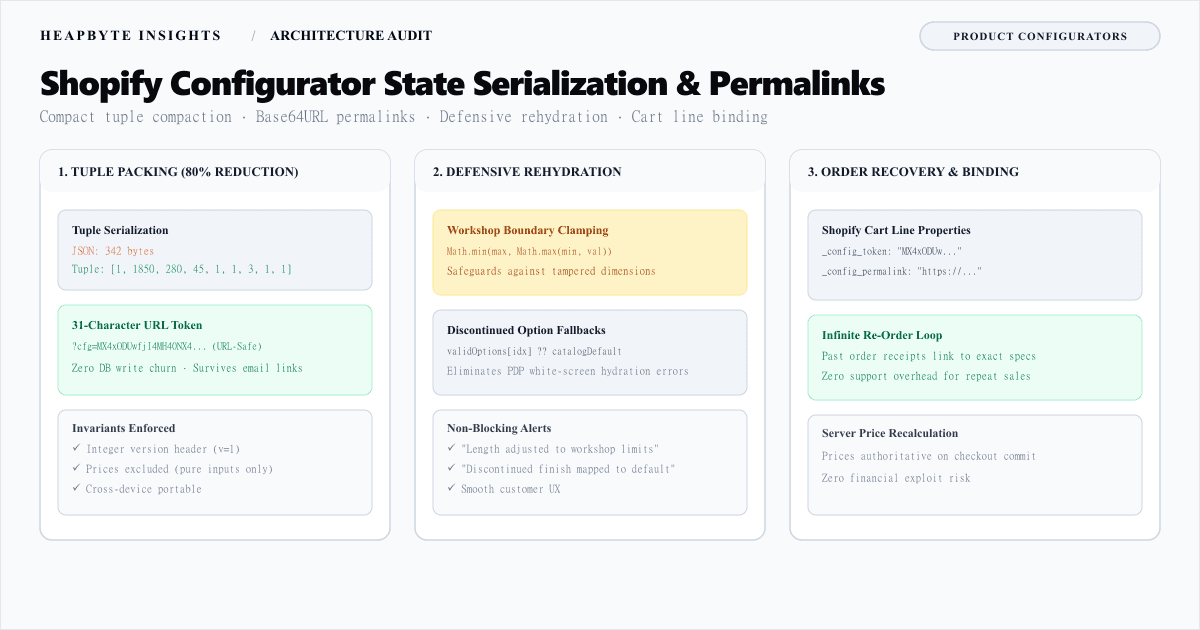
The ephemeral configuration trap: why local storage and raw query strings break custom commerce
When developers build bespoke product customisers on Shopify, they usually treat state persistence as an afterthought. Most implementations adopt one of three flawed patterns.
The first pattern is isolated browser storage (localStorage or sessionStorage). The configurator UI saves the active dimensions, options, and finishes to the customer's browser storage. This functions smoothly during a single browsing session on a single laptop. However, it completely breaks cross-device continuity. When a contractor configures commercial shelving on an office workstation and attempts to review the specification on a phone while standing on the jobsite, the phone has zero access to the workstation's local storage. Similarly, opening the site in a private browsing tab or across different browsers wipes the session clean.
The second pattern is server-side session database bloat. To bypass local storage limitations, some custom app developers store every configuration state in an external PostgreSQL or Redis database, issuing a random UUID token like ?config=c4a8f192-3b2e. While this keeps URLs tidy, it introduces massive write amplification: for every customer who purchases, fifty visitors experiment with dimensional sliders and colour pickers without buying. In a store receiving 100,000 monthly sessions, logging draft configurations on every debounce creates millions of orphaned database rows. Furthermore, rehydrating the PDP requires an asynchronous network trip before the configurator can mount, risking frozen unconfigured states during cold starts.
The third pattern is naive query parameter dumping. Appending sixty uncompressed parameters to the address bar causes URLs to exceed 2,000 characters. Email applications (Outlook, Apple Mail), messaging apps (WhatsApp, Slack, Microsoft Teams), and SMS gateways aggressively wrap or truncate long URLs, corrupting the configurator payload. Modern privacy browsers (such as iOS Safari Advanced Tracking Protection) also strip query parameters that resemble tracking tokens. In our configurator architecture for Custom Floating Shelves and window dimensioning workflows for Vorhang Schweiz, we resolved this by implementing compact client-side state serialization directly in the storefront code.
Compact bitmask packing and URL-safe Base64 state encoding
A production configurator state does not require thousands of bytes of descriptive JSON strings. Most configuration parameters fall into three distinct data shapes: bounded numeric dimensions, enumerated selections from a finite catalog set, and boolean accessory toggles.
Instead of serializing verbose keys and string values, our architecture packs the state into a fixed binary or compact array format, prepends an integer schema version header, and serializes the result into a URL-safe Base64 string (using '-' and '_' instead of '+' and '/', omitting trailing padding '=' characters).
By encoding state into a 38-character token (?cfg=AX4K2AAtAiEBMAE), the entire configuration permalink easily fits within SMS and corporate email limits. The token operates completely client-side without pinging a database, executes with sub-millisecond decode times, and provides a permanent, immutable representation of the customer's design.
Client-side schema versioning and defensive rehydration validation
The critical flaw in many serialization engines is assuming catalog data remains static forever. In reality, ecommerce catalogs evolve continuously.
Consider what occurs when a customer shares a configuration permalink, and their interior designer opens the link four weeks later: the workshop may have discontinued the specific 'Smoked Ash' timber finish, the minimum manufactured length may have shifted from 300mm to 400mm due to machinery upgrades, or a new mandatory hardware option may have been added to the product schema.
If a configurator blindly unpacks the serialized state and injects it into the UI, it will trigger React state exceptions, render broken dropdowns, or quote obsolete prices that cannot be honoured in production.
To prevent this, the rehydration pipeline enforces three architectural safeguards: (1) an integer schema versioning header that triggers migration adapters, (2) defensive boundary clamping against live catalog constraints, and (3) graceful fallbacks for discontinued finishes and options that log non-blocking informational notices rather than white-screening the PDP.
import assert from "node:assert/strict";

export interface ConfiguratorState {
  version: number;
  lengthMm: number;
  depthMm: number;
  thicknessMm: number;
  timberCode: string;
  finishCode: string;
  bracketCount: number;
  hasLedChannel: boolean;
  cableExitSide: "left" | "right" | "none";
}

export interface CatalogConstraints {
  minLengthMm: number;
  maxLengthMm: number;
  minDepthMm: number;
  maxDepthMm: number;
  validTimbers: string[];
  validFinishes: string[];
  defaultTimber: string;
  defaultFinish: string;
}

export interface RehydrationResult {
  state: ConfiguratorState;
  wasClamped: boolean;
  fallbackApplied: boolean;
  notices: string[];
}

export class ConfiguratorStateSerializer {
  private static readonly CURRENT_VERSION = 1;

  constructor(private constraints: CatalogConstraints) {}

  public serializeToToken(state: ConfiguratorState): string {
    const timberIndex = Math.max(0, this.constraints.validTimbers.indexOf(state.timberCode));
    const finishIndex = Math.max(0, this.constraints.validFinishes.indexOf(state.finishCode));
    const cableCode = state.cableExitSide === "left" ? 1 : state.cableExitSide === "right" ? 2 : 0;
    const ledCode = state.hasLedChannel ? 1 : 0;

    const tuple = [
      ConfiguratorStateSerializer.CURRENT_VERSION,
      Math.round(state.lengthMm),
      Math.round(state.depthMm),
      Math.round(state.thicknessMm),
      timberIndex,
      finishIndex,
      state.bracketCount,
      ledCode,
      cableCode,
    ];

    const rawString = tuple.join("~");
    return Buffer.from(rawString, "utf8")
      .toString("base64url")
      .replace(/=/g, "");
  }

  public deserializeToken(token: string): RehydrationResult {
    const notices: string[] = [];
    let wasClamped = false;
    let fallbackApplied = false;

    if (!token || typeof token !== "string") {
      throw new Error("Invalid or empty configuration token");
    }

    let rawString: string;
    try {
      rawString = Buffer.from(token, "base64url").toString("utf8");
    } catch {
      throw new Error("Failed to decode Base64URL configuration token");
    }

    const parts = rawString.split("~").map((val) => Number.parseInt(val, 10));
    if (parts.length < 9 || parts.some(Number.isNaN)) {
      throw new Error("Malformed configuration tuple structure");
    }

    const [
      version,
      rawLength,
      rawDepth,
      rawThickness,
      timberIdx,
      finishIdx,
      rawBrackets,
      rawLed,
      rawCable,
    ] = parts;

    if (version !== ConfiguratorStateSerializer.CURRENT_VERSION) {
      notices.push(`Migrated configuration from legacy schema version ${version}`);
    }

    let lengthMm = rawLength;
    if (lengthMm < this.constraints.minLengthMm) {
      lengthMm = this.constraints.minLengthMm;
      wasClamped = true;
      notices.push(`Length adjusted to minimum workshop capability (${this.constraints.minLengthMm}mm)`);
    } else if (lengthMm > this.constraints.maxLengthMm) {
      lengthMm = this.constraints.maxLengthMm;
      wasClamped = true;
      notices.push(`Length adjusted to maximum workshop capability (${this.constraints.maxLengthMm}mm)`);
    }

    let depthMm = rawDepth;
    if (depthMm < this.constraints.minDepthMm) {
      depthMm = this.constraints.minDepthMm;
      wasClamped = true;
      notices.push(`Depth adjusted to minimum allowable shelf projection (${this.constraints.minDepthMm}mm)`);
    } else if (depthMm > this.constraints.maxDepthMm) {
      depthMm = this.constraints.maxDepthMm;
      wasClamped = true;
      notices.push(`Depth adjusted to maximum allowable shelf projection (${this.constraints.maxDepthMm}mm)`);
    }

    let timberCode = this.constraints.validTimbers[timberIdx];
    if (!timberCode) {
      timberCode = this.constraints.defaultTimber;
      fallbackApplied = true;
      notices.push(`Selected timber is no longer available. Reverted to ${timberCode}`);
    }

    let finishCode = this.constraints.validFinishes[finishIdx];
    if (!finishCode) {
      finishCode = this.constraints.defaultFinish;
      fallbackApplied = true;
      notices.push(`Selected finish is no longer available. Reverted to ${finishCode}`);
    }

    const cableExitSide: "left" | "right" | "none" =
      rawCable === 1 ? "left" : rawCable === 2 ? "right" : "none";

    const rehydratedState: ConfiguratorState = {
      version,
      lengthMm,
      depthMm,
      thicknessMm: Math.max(20, rawThickness),
      timberCode,
      finishCode,
      bracketCount: Math.max(2, rawBrackets),
      hasLedChannel: rawLed === 1,
      cableExitSide,
    };

    return {
      state: rehydratedState,
      wasClamped,
      fallbackApplied,
      notices,
    };
  }

  public generatePermalink(baseUrl: string, state: ConfiguratorState): string {
    const token = this.serializeToToken(state);
    const url = new URL(baseUrl);
    url.searchParams.set("cfg", token);
    return url.toString();
  }

  public buildCartLineProperties(
    state: ConfiguratorState,
    storefrontUrl: string
  ): Record<string, string> {
    const token = this.serializeToToken(state);
    const permalink = this.generatePermalink(storefrontUrl, state);

    return {
      "Custom Dimensions": `${state.lengthMm}mm W × ${state.depthMm}mm D × ${state.thicknessMm}mm T`,
      Timber: state.timberCode.replace(/_/g, " ").toUpperCase(),
      Finish: state.finishCode.replace(/_/g, " ").toUpperCase(),
      "Bracket Count": `${state.bracketCount} Heavy-Duty Stud Brackets`,
      "Lighting Option": state.hasLedChannel ? `Integrated LED (${state.cableExitSide} exit)` : "None",
      _config_token: token,
      _config_permalink: permalink,
      _schema_version: state.version.toString(),
    };
  }
}Cart property binding and multi-session order recovery
Generating a shareable permalink is only half the battle. When the customer finally clicks 'Add to Cart', the serialized state must seamlessly bridge into the Shopify order lifecycle.
In custom configurator engineering, attaching the raw configuration token to line item properties provides four enterprise operational advantages: (1) zero-overhead repeat orders where confirmation emails render the permalink so customers reload identical specs in one click, (2) clear fulfillment inspection where workshop staff view both readable summaries and machine tokens, (3) cart drawer continuity where the token acts as an invariant hash binding parent items to companion add-ons, and (4) checkout extensibility integration where custom Checkout UI Extensions read the token to calculate freight surcharges without querying external state databases.
For stores pairing state serialization with child hardware components, review our architecture for Shopify configurator cart decomposition and computed price authority on Shopify.
When this needs an engineer
You do not need a custom state serialization engine if you are selling standard catalog products with simple dropdown options (such as size and colour variants). Shopify's native variant ID query parameter handles single-click selection cleanly. Similarly, basic monogram apps attach line item properties adequately without deep linking requirements.
You need custom state serialization and permalink architecture when: your product pricing and geometry are continuously computed from multi-dimensional numeric inputs that cannot be mapped to enumerable Shopify variants; your sales cycle involves trade collaboration where interior designers, architects, estimators, or spouses must email and review exact custom specifications before buying; your database is experiencing write amplification from custom app servers logging thousands of draft session configurations that never convert; or customers frequently contact support to re-order complex past specifications.
Explore our engineering services in product configurator development, inspect our configurators case study collection, or review how bespoke configurators were delivered in the Custom Floating Shelves case study.
Send us the store and the symptom. We will architect a configurator state serialization engine that enables effortless collaboration while protecting catalog integrity.