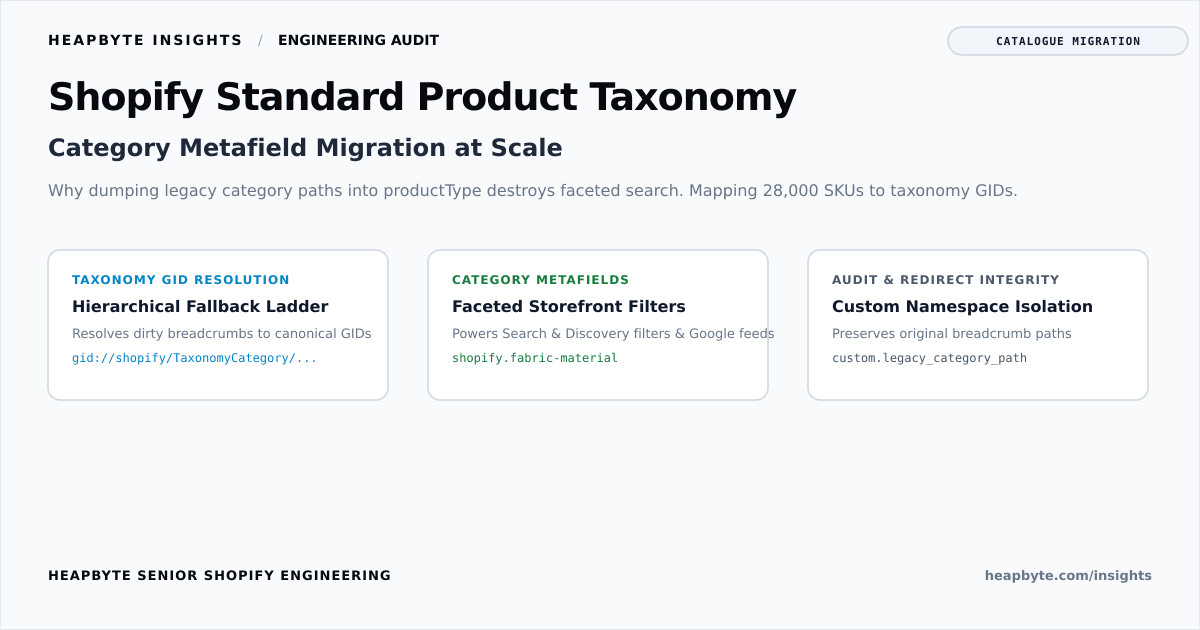
The productType trap: why free-form strings break modern Shopify
In legacy ecommerce systems like Magento, WooCommerce, or bespoke SAP/ERP setups, categorization is typically modeled as a deeply nested, multi-parent category tree.
When teams first encounter Shopify, they frequently mistake the single product_type field as the destination for this entire hierarchy, dumping raw concatenated strings like 'Textiles > Upholstery > Velvet' into the field.
This shortcut causes structural failures: storefront search and discovery filters cannot parse delimiter strings, Google Shopping flags feed rejections for missing categories, and Shopify's semantic search engine cannot classify items.
During our catalog structuring work for The Fabric Co. and digital audio migration for Lantern Indie Audiobooks, we solved these issues by establishing a programmatic taxonomy mapping pipeline, transforming unstructured supplier feeds into strictly typed Shopify taxonomy structures.
- Storefront faceted filter paralysis: Search & Discovery filters cannot bind to unstructured productType strings
- Loss of automated category metafields: Bypasses native attributes like fabric-material and pattern-type
- Marketplace feed warnings: Triggers compliance flags in Google Merchant Center and Meta Catalogs
- Semantic search degradation: Prevents Shopify's embedding engine from matching buyer search intent
Understanding Shopify's Standard Product Taxonomy and category metafields
The Shopify Standard Product Taxonomy is a comprehensive, publicly available hierarchical classification containing over 5,000 standardized product categories, structured as Global Identifiers (gid://shopify/TaxonomyCategory/...).
Every taxonomy node defines an allowed set of category metafield definitions. For example, assigning Upholstery Fabric automatically enables fabric-material, pattern-type, and fabric-weight.
When creating or updating products via the GraphQL Admin API (productCreate or productUpdate), developers pass the category GID directly in the category input argument. Passing raw text throws an immediate validation error.
Algorithmic category resolution: breadcrumb tokenization and ancestor fallbacks
Legacy catalogs rarely map one-to-one with Shopify's taxonomy tree. A supplier catalog might define categories using arbitrary separators, abbreviations, or hyper-specific niche leaves that do not exist as exact nodes in Shopify's graph.
A production migration pipeline implements a multi-stage category resolution ladder: path normalisation, exact full-path matching, leaf segment resolution, hierarchical ancestor fallback, token similarity scoring, and root fallback.
Traversing backwards up the breadcrumb ladder when a leaf is unmapped ensures 90% attribute compatibility rather than failing the import entirely.
import assert from "node:assert/strict";

export interface TaxonomyCategoryNode {
  id: string;
  fullName: string;
  name: string;
  parentId?: string;
  allowedMetafieldKeys: string[];
}

export interface LegacyProductRecord {
  productId: string;
  legacyCategoryPath: string;
  title: string;
  rawAttributes: Record<string, string>;
}

export interface ResolvedCategoryMetafield {
  namespace: string;
  key: string;
  value: string;
  type: "single_line_text_field" | "list.single_line_text_field" | "number_integer";
}

export interface ProductTaxonomyMigrationPlan {
  productId: string;
  matchedTaxonomyCategoryId: string;
  matchedTaxonomyCategoryName: string;
  matchType: "EXACT" | "HIERARCHICAL_ANCESTOR" | "TOKEN_SIMILARITY" | "ROOT_FALLBACK";
  matchConfidence: number;
  categoryMetafields: ResolvedCategoryMetafield[];
  customMetafields: ResolvedCategoryMetafield[];
  auditBreadcrumb: string;
}

export interface TaxonomyCatalogDictionary {
  categories: TaxonomyCategoryNode[];
  attributeKeyMap: Record<string, string>;
  valueNormalizerMap: Record<string, string>;
  rootFallbackCategoryId: string;
}

export function tokenizeCategoryPath(path: string): string[] {
  return path
    .split(/[>/\\|]/)
    .map((seg) => seg.trim().toLowerCase())
    .filter((seg) => seg.length > 0);
}

export function resolveProductTaxonomyAndMetafields(
  product: LegacyProductRecord,
  catalog: TaxonomyCatalogDictionary
): ProductTaxonomyMigrationPlan {
  const { categories, attributeKeyMap, valueNormalizerMap, rootFallbackCategoryId } = catalog;
  const legacyTokens = tokenizeCategoryPath(product.legacyCategoryPath);
  const normalizedLegacyPath = legacyTokens.join(" > ");

  let matchedCategory: TaxonomyCategoryNode | undefined;
  let matchType: "EXACT" | "HIERARCHICAL_ANCESTOR" | "TOKEN_SIMILARITY" | "ROOT_FALLBACK" = "ROOT_FALLBACK";
  let matchConfidence = 0.0;

  matchedCategory = categories.find(
    (c) => c.fullName.toLowerCase() === normalizedLegacyPath || c.name.toLowerCase() === normalizedLegacyPath
  );
  if (matchedCategory) {
    matchType = "EXACT";
    matchConfidence = 1.0;
  }

  if (!matchedCategory && legacyTokens.length > 0) {
    const leafToken = legacyTokens[legacyTokens.length - 1];
    matchedCategory = categories.find((c) => c.name.toLowerCase() === leafToken);
    if (matchedCategory) {
      matchType = "EXACT";
      matchConfidence = 0.95;
    }
  }

  if (!matchedCategory && legacyTokens.length > 1) {
    for (let i = legacyTokens.length - 2; i >= 0; i--) {
      const ancestorToken = legacyTokens[i];
      const candidate = categories.find((c) => c.name.toLowerCase() === ancestorToken);
      if (candidate) {
        matchedCategory = candidate;
        matchType = "HIERARCHICAL_ANCESTOR";
        matchConfidence = 0.8;
        break;
      }
    }
  }

  if (!matchedCategory && legacyTokens.length > 0) {
    let bestScore = 0;
    let bestCandidate: TaxonomyCategoryNode | undefined;

    for (const cat of categories) {
      const catTokens = tokenizeCategoryPath(cat.fullName);
      const sharedTokens = legacyTokens.filter((t) => catTokens.includes(t));
      const score = sharedTokens.length / Math.max(legacyTokens.length, catTokens.length);

      if (score > bestScore && score >= 0.4) {
        bestScore = score;
        bestCandidate = cat;
      }
    }

    if (bestCandidate) {
      matchedCategory = bestCandidate;
      matchType = "TOKEN_SIMILARITY";
      matchConfidence = Math.round(bestScore * 100) / 100;
    }
  }

  if (!matchedCategory) {
    matchedCategory = categories.find((c) => c.id === rootFallbackCategoryId) ?? {
      id: rootFallbackCategoryId,
      fullName: "General Merchandise",
      name: "General Merchandise",
      allowedMetafieldKeys: [],
    };
    matchType = "ROOT_FALLBACK";
    matchConfidence = 0.1;
  }

  const categoryMetafields: ResolvedCategoryMetafield[] = [];
  const customMetafields: ResolvedCategoryMetafield[] = [];

  for (const [rawKey, rawValue] of Object.entries(product.rawAttributes)) {
    const normalizedKey = rawKey.trim().toLowerCase();
    const mappedCategoryKey = attributeKeyMap[normalizedKey];

    if (mappedCategoryKey && matchedCategory.allowedMetafieldKeys.includes(mappedCategoryKey)) {
      const normalizedValueKey = rawValue.trim().toLowerCase();
      const standardValue = valueNormalizerMap[normalizedValueKey] ?? rawValue.trim();

      categoryMetafields.push({
        namespace: "shopify",
        key: mappedCategoryKey,
        value: standardValue,
        type: "single_line_text_field",
      });
    } else {
      const safeCustomKey = normalizedKey.replace(/[^a-z0-9_]/g, "_");
      customMetafields.push({
        namespace: "custom",
        key: safeCustomKey,
        value: rawValue.trim(),
        type: "single_line_text_field",
      });
    }
  }

  customMetafields.push({
    namespace: "custom",
    key: "legacy_category_path",
    value: product.legacyCategoryPath,
    type: "single_line_text_field",
  });

  return {
    productId: product.productId,
    matchedTaxonomyCategoryId: matchedCategory.id,
    matchedTaxonomyCategoryName: matchedCategory.name,
    matchType,
    matchConfidence,
    categoryMetafields,
    customMetafields,
    auditBreadcrumb: product.legacyCategoryPath,
  };
}Normalising heterogeneous supplier attributes into predefined taxonomy enums
Assigning a product to a valid taxonomyCategory unlocks standard category metafield keys, but Shopify enforces strict value validation on predefined taxonomy attributes.
If a supplier provides raw attribute strings such as '100% Pure Organic Mulberry Silk', passing that raw string into Shopify's shopify.fabric-material metafield will be rejected if the taxonomy schema expects a single standardized enum value ('silk').
A robust migration pipeline normalises attribute keys to canonical taxonomy identifiers and standardises values against controlled taxonomy vocabularies, routing non-standard attributes to the custom namespace.
For detailed patterns on managing custom and standard metafield schemas, review our architectural guide on Shopify metafield definitions migration and type casting.
Preserving legacy navigation and 301 SEO redirects with audit breadcrumbs
When migrating an enterprise store with 28,000 products, preserving SEO equity is just as vital as clean collection filtering.
On legacy platforms, category paths often determined product URLs. On Shopify, product URLs are flat (/products/handle).
Our migration pipeline serialises the raw legacy category path directly into a dedicated custom metafield: custom.legacy_category_path. This enables automated 301 URL redirect map generation, deterministic pipeline re-runs, and full data parity verification.
When this needs an engineer
You do not need a custom taxonomy migration engine if your store has fewer than 200 products, if your catalog already uses standard Shopify taxonomy categories, or if your legacy store had a flat, simple single-level collection structure.
You need an engineer when migrating complex enterprise catalogs: when tens of thousands of SKUs span deeply nested, legacy category trees; when raw supplier attributes must be parsed, deduplicated, and mapped to Shopify's Standard Product Taxonomy; when Search & Discovery faceted filters and Google Merchant Center feeds must operate flawlessly on launch day; and when legacy category paths must be preserved to generate automated 301 redirect maps across large product catalogs.
Explore our engineering services in Shopify catalog migration, inspect our catalogue migration case study collection, review our architecture for staged product image uploads at scale, or review how large-scale inventory was structured in The Fabric Co. case study.
Send us your legacy catalog export, category hierarchy sample, and attribute definitions. We will architect a clean, automated taxonomy migration pipeline that keeps your catalog structured, searchable, and compliant.